


In our last article, The power of less, we made the case for reducing packaging. Less plastic means less that can end up in the environment. It means lower EPR fees. And it means lighter loads on every truck.
Since then, one question keeps coming up with customers: how?
It’s a fair question. You can’t just pull material out of a package and hope for the best. A film that fails on the line, splits in the case or lets oxygen in, doesn’t reduce waste. It creates more of it.
So using less doesn’t start with thickness. It starts with picking the right material for the job.
Every layer should earn its place
Most flexible food packaging isn’t one material. A barrier film or shrink bag is an engineered stack of layers, and each layer has a job:
Polyethylene (PE)
For sealing, moisture protection and toughness.
Nylon (PA)
For puncture resistance, strength and barrier.
EVOH
For oxygen barrier, protecting shelf life and colour.
Polypropylene (PP)
For stiffness and heat resistance.
Here’s the catch. Structures often outlive the reasons they were chosen. A film spec’d for bone-in product ends up running on boneless cuts. A barrier level picked for a long export program stays on a product that sells through in three weeks. A few microns get added “just to be safe” after one bad run, and they never come back out.
None of those calls were wrong at the time. But over the years, they add up to packaging built for a worst case the product no longer faces. Every extra micron is material you pay for, ship and report under EPR.
So before we take anything out, we ask a few simple questions:
- What does this product really need protection from? Oxygen, moisture, punctures, light, temperature abuse?
- How much shelf life does it need, from the packing floor to the consumer’s fridge?
- How is it packed, shipped and displayed?
- Which layers are doing real work, and which are left over from an old spec?
The answers often point to a different structure, not just a thinner version of the same one.
Sometimes using less means going thicker
Here’s where it gets interesting. “Less” isn’t only measured in microns.
When we move a customer from a nylon-based structure to a recycle-ready polyolefin one, a gauge-for-gauge swap often isn’t possible. Nylon packs a lot of puncture resistance and forming performance into a thin layer. To match it, a PE-based film usually has to be thicker. And for some deep-draw or sharp-bone applications, nylon is still the right answer.
A thicker film sounds like a step backward. It isn’t necessarily. Nylon is carbon-intensive to make. One peer-reviewed life cycle assessment found that producing nylon 6 has about four times the greenhouse gas impact of HDPE or LLDPE, kilogram for kilogram. Nylon is also about 25% denser than PE, so a thicker PE film adds less weight than the gauge change suggests.
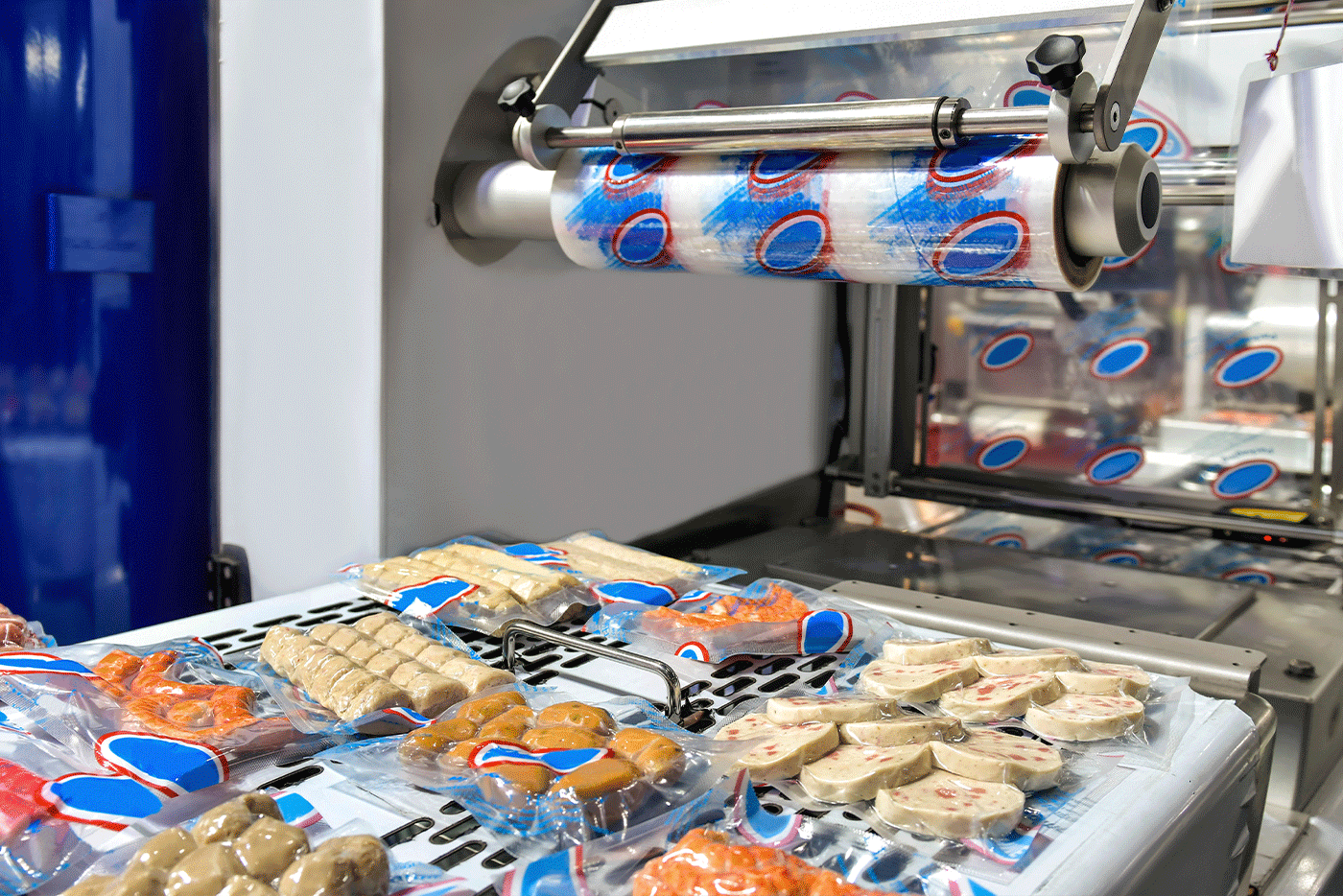
Put those together and the math often works in our favour. In the structures we’ve compared, moving from a nylon-containing film to a polyolefin one has typically cut greenhouse gas emissions by around 10%, even after accounting for the added thickness. Where we can also improve yield or reduce the weight of the rest of the structure, the benefit grows.
One honest caveat: EPR fees are charged by weight, so if the new film is heavier, the fee can go up slightly even as the carbon footprint comes down. That’s a trade-off we walk through with every customer.
So the goal isn’t always the thinnest film. It’s the lowest overall impact from a package that still does its job.
Performance comes first
Reduction only makes sense if the package still protects the product. Food waste has its own footprint: the feed, water and energy that went into producing it, plus processing and transport. When a package fails, all of that is lost.
That’s why every material change gets tested against the real application:
Shelf life:
Does the barrier hold for the full product lifecycle?
Seal integrity:
Do seals hold through fat, bone, contamination and temperature swings?
Abuse resistance:
Does the pack survive boxing, shipping, stacking and handling at retail?
Line performance:
Does it run at the same speed, with the same yields and no extra rework?
That last one is easy to miss. A film that saves 10% on material but slows the line, adds leakers or causes rewraps can cost more than it saves, in dollars and in waste. The only way to know for sure is to trial it on the customer’s own equipment, with their own product.
The bigger picture
When the material matches the application, the benefits stack up:
- Lower material costs: less resin per package on every run.
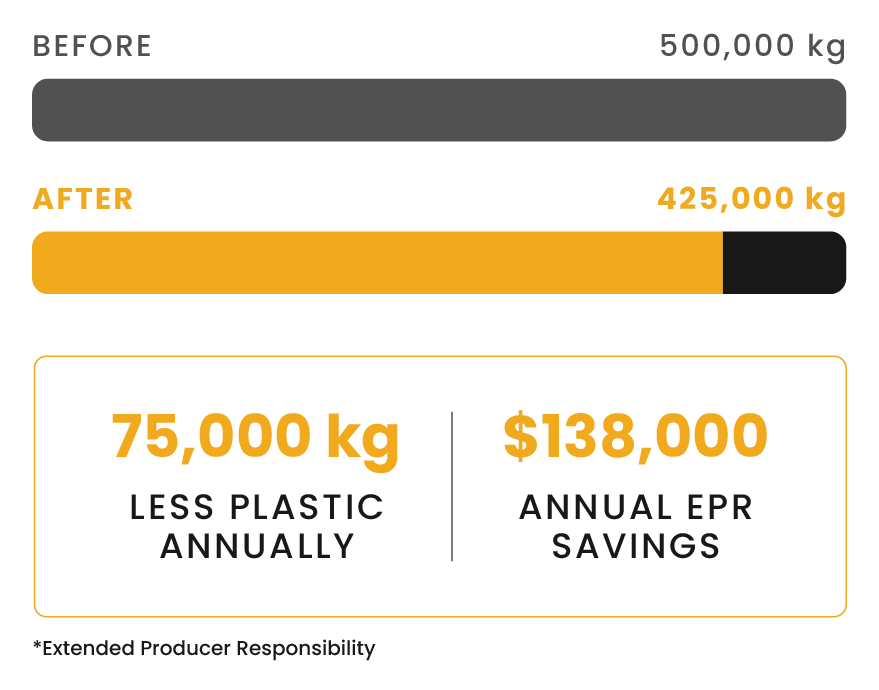
- Lower EPR fees: stewardship fees are charged by weight. At Recycle BC’s 2026 rate of $1.84/kg for plastic film and laminates, a 15% reduction on 500,000 kg of film supplied into BC removes 75,000 kg. That’s about $138,000 a year in fees alone.
- Lighter transport: less weight, and often better cube from pallet to truck.
- Less waste: fewer kilograms of packaging in the waste stream, no matter what happens at end of life.
- Simpler structures: fewer materials in a package make it easier to recycle as infrastructure grows.
How we approach it
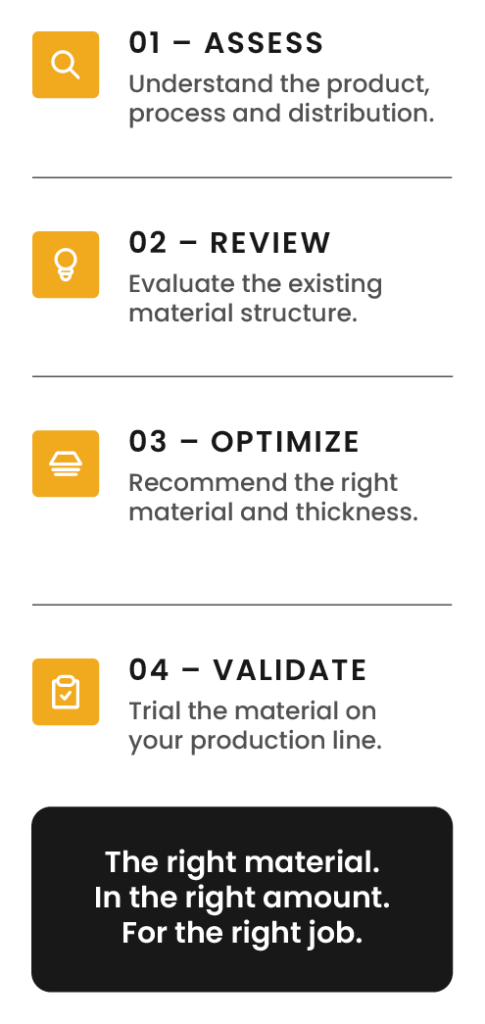
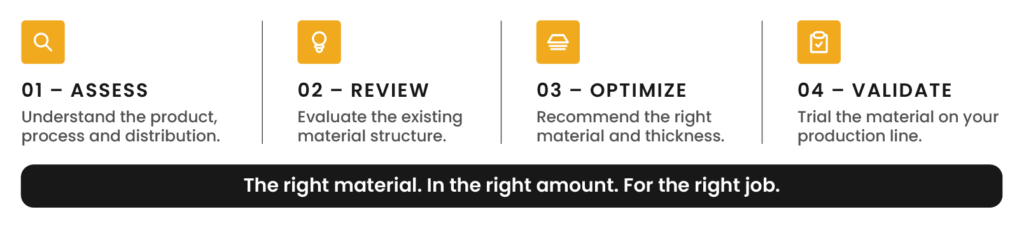
At Duropac, we start with the application, not the catalogue. We look at the product, the process and the distribution chain. We review what the current structure is actually doing. Then we recommend options: a downgauged version of a proven film, a different structure, or one of our recycle-ready alternatives. And we trial it on your line before anything changes.
The takeaway
Sustainable packaging isn’t just about using less plastic. It’s about using the right amount of the right material for the job. Get the material right, and the reduction follows, without giving up protection, shelf life or performance.
Next time, we’ll tackle a question we heard over and over at this year’s trade shows: what does “recycle-ready” really mean?
Sources
- Duropac, The power of less: Why reducing packaging matters more than ever (downgauging example; Recycle BC 2026 rate of $1.84/kg)
- University at Buffalo, A cradle-to-grave life cycle assessment of multilayer plastic film food packaging materials, comparing to a paper-based alternative (nylon 6 vs HDPE/LLDPE GHG impact)
- Canada Plastics Pact, Golden Design Rules for Plastic Packaging

About the Author
Keith Dunne:
Keith brings over 30 years of expertise in the packaging industry, with a proven track record in both flexible and rigid packaging solutions. He is certified in Business Sustainability Management, combining deep technical knowledge with a strong commitment to driving sustainable practices in the sector.
Share post